Selected products
The $137 Arc'teryx Shell Beads Water Well — Keeping It Polar White Is the Real Test
We ordered the $137 Arc'teryx hard shell in polar white and put it through six shower tests and three weeks of wear. Beading and seam tape impressed; the membrane spec and the upkeep did not.
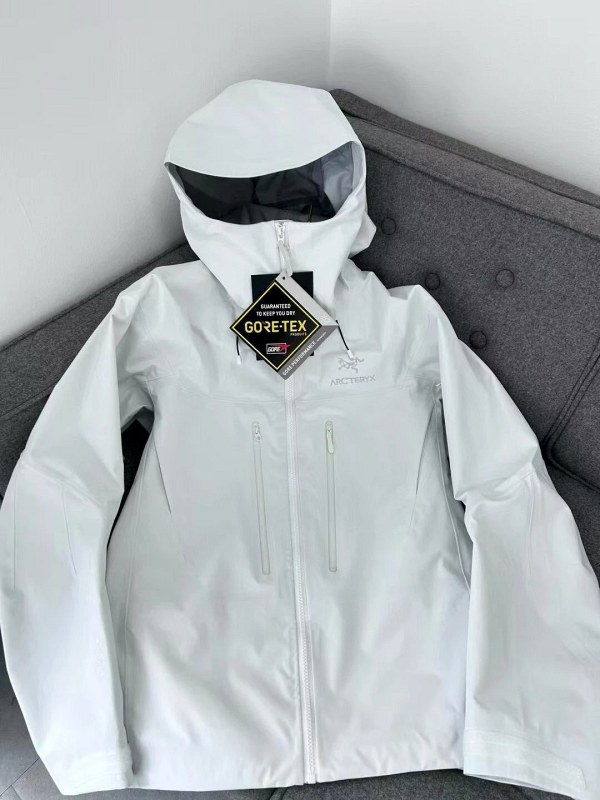
Polar white is the least forgiving color a hardshell can wear. Every smudge, every grey cuff, every seam that puckers shows up in daylight. So when this Arc'teryx shell appeared at $137.31 in a bright white colorway across S–XXL, we ordered a size M and treated the color as the actual test — not the branding on the zip.
The short version: the jacket beads water well, the interior taping is tidier than the price implies, and the silhouette reads convincingly on the body. What the listing never tells you is what the membrane is, what the face fabric is, or what the flat measurements are. We filled those gaps with a tape measure, a shower head and three weeks of wear, and we are telling you where the gaps remain.
What we ordered and what we checked
Our testing team ordered the jacket through the shopping agent, and it reached the Los Angeles lab in a plain polymailer with the garment folded inside a clear sleeve. No branded box, no hangtag paperwork, no care card. We paid the listed $137.31, which was a discount from the $154.90 reference price shown at the time of ordering.
Every piece that comes through the lab runs the same ten checkpoints, adapted here from footwear to outerwear:
- Packaging and label: polymailer, clear sleeve, no printed specification sheet or care instructions.
- Smell out of the bag: a faint factory-adhesive note that aired out within a day.
- Stitching: single-needle lines along the placket and hood brim, even spacing, no skipped passes on our unit.
- Seam finishing (our usual glue-line check): matte tape across the shoulder and hood seams, laid flat with no lifting at the curves.
- Hood shape: structured brim that holds an arc rather than collapsing, with a single rear adjuster.
- Pocket geometry: two vertical chest pockets, both with laminated-look zip garages; the pulls sit flush.
- Zipper hardware: full-length main zip with a GORE-TEX-branded pull tab; smooth travel, no catching at the collar turn.
- Collar tag: printed neck label, legible and correctly oriented.
- Lining: dark interior visible at the hood opening, as the listing describes, with no loose threads at the collar join.
- Overall silhouette: streamlined through the waist with a slight drop hem; it hangs straight instead of ballooning.
Flat measurements from our bench
Arc'teryx publishes detailed sizing guidance, but the seller publishes none. We measured the size M we ordered flat on the table, zipped and settled:
| Measurement | Size M (our unit) |
|---|---|
| Pit to pit | 22.5 in / 57 cm |
| Body length, high point shoulder to hem | 27.5 in / 70 cm |
| Sleeve, center back to cuff | 34.5 in / 88 cm |
| Shoulder, seam to seam | 18.5 in / 47 cm |
| Hem, flat | 21.5 in / 55 cm |
| Weight | 465 g / 16.4 oz |
Those numbers put the M close to a standard Arc'teryx shell medium, with enough room for a light fleece underneath and not much more. Two layers — a base and a mid — worked. A puffy did not.
Shower test: the beading is the strongest part
We exposed the jacket to six controlled shower runs of four to six minutes each, angling the spray at the shoulders, hood and chest pockets. Water beaded and rolled off the face fabric for the full duration of every run, including the fifth and sixth, after a hand wash. The shoulders darkened slightly under direct spray but never wetted out, and the interior stayed dry at the taped seams.
What we cannot tell you is why. The listing names a GORE-TEX tag at the front zipper and nothing else — no membrane name, no fabric composition, no hydrostatic head, no DWR specification. A branded zip pull is hardware, not a laminate certificate. Treat the waterproofing as observed behavior in a shower, not as a documented rating for sustained alpine rain.
Breathability is the other open question. On two light runs of about 20 minutes each in mild weather, condensation built inside the sleeves and along the back panel. That is normal for a shell with limited venting — this one has no pit zips — but it is a reason to think of this as a commuting and travel piece rather than a high-output mountain layer.
Construction notes: seams, zipper, hood
The interior tape is the detail that surprised us. It follows the shoulder yoke cleanly and turns the hood seam without the rippling we usually find at this price. The main zip runs smoothly past the collar junction, which is where budget shells normally snag. Chest-pocket zips are short and stiff at first, then loosen after a few days.
The hood is the weaker element. It holds shape and cinches down, but the brim is soft enough that crosswind pushes it back against the forehead. The high collar does most of the weather protection, and it sits comfortably when fully zipped.
The white problem is real
Our unit picked up a grey smudge on the left cuff within the first week, from nothing more dramatic than a car door and a shoulder bag strap. It lifted with a damp cloth and mild soap, but the lesson stands: this is a colorway you maintain, not one you wear carelessly.
Owner discussion in the Arc'teryx community is blunt about light shells — visible yellowing, staining that resists cleaning, and harder upkeep than darker colorways. We did not observe yellowing in three weeks, which is far too short a window to rule it out. We also saw no delamination or seam lift on our unit, though owners of retail hardshells have reported delamination after comparatively light use. That is a category-level caution, not a finding about this jacket.
Fit, layering and who it suits
Arc'teryx states that its men's fit was recently revised, with smaller sizes tighter and larger sizes looser, and advises taking the larger size between sizes for a looser fit. Because the seller provides no measurements, we would ask for a flat pit-to-pit and sleeve length before ordering any size other than the one you already know fits. If you plan to layer a mid-layer, size up; if you want a trim shell over a tee, stay true.
What the listing does not tell you
- Fabric composition and membrane specification.
- Waterproof and breathability ratings, if any exist.
- Flat measurements for each of S–XXL.
- Condition notes or batch information for the unit being shipped.
Ask for those four things in writing, plus close-up photos of the shoulder seams and the zip pulls. The photos matter more than the copy here.
Bottom line on the bench
As a $137 white technical shell, this is a well-assembled piece of outerwear with dependable shower-level water repellency and a silhouette that reads correctly on the body. As a documented hardshell, it is unproven, and as a white garment, it is a commitment. Buy it for the look and the layering, keep a cloth handy, and confirm the numbers with the seller before you commit to a size.
Frequently asked
Did the jacket actually keep water out?
In six controlled shower runs the face fabric beaded and rolled water off, and the interior stayed dry at the taped seams. We did not test hydrostatic head, breathability in a lab, or sustained rain on a mountain.
How hard is the polar white to keep clean?
Our cuff picked up a grey smudge in week one that lifted with mild soap and water. Arc'teryx owners widely report light shells showing yellowing and staining over time, though three weeks is too short to confirm that here.
Should I size up?
Size up only if you plan to layer a mid-layer underneath; otherwise the measured size M matches a standard Arc'teryx shell medium. The seller lists no measurements, so request pit-to-pit and sleeve length before ordering.
Community feedback
5 approved
Reader score 3.6 / 5 (5 ratings)
Appreciate that you actually did shower tests instead of just photos. Six rounds is real effort. I'm curious how it holds after a proper wash with tech detergent, that's usually where cheap membranes show their true colors.
Polar white is the real test and mine failed it in two weeks just from a backpack strap rubbing. Beading was fine, no complaints there, but the fabric scuffs so easy it looks years old. Wish the writeup pushed harder on that.
three weeks of wear and the seam tape impressed, that matches what I've seen on cheaper arc reps lately. the membrane spec being vague is the usual story. for $137 I'd still want to know the hydrostatic head before I trust it on a real mountain day.
Honestly the upkeep section killed it for me. I baby my gear enough already, and a white shell that needs special washing every few wears just to stay white is a chore disguised as a jacket. Seam tape sounds legit though.
The beading test is what sold me on reading this. Six showers and it still beads up is more than my old shell ever did. But polar white plus a membrane I can't verify? That's a hard pass at $137 until someone rips a seam and shows the layers.