Rick Owens High-Top Sizing: Measure Insole Length
- Editorial notes
Sizing advice for these Rick Owens black leather high-tops cannot be simply summed up as "true to size" or "size down across the board." The product page lists a cowhide leather upper, stitched rubber sole, lace-up closure, black colorway, and unisex sizing 36–47; however, existing sizing resources for similar high-top models are inconsistent, with recommendations ranging from size down one, true to size, to size down half. Therefore, the safest appro
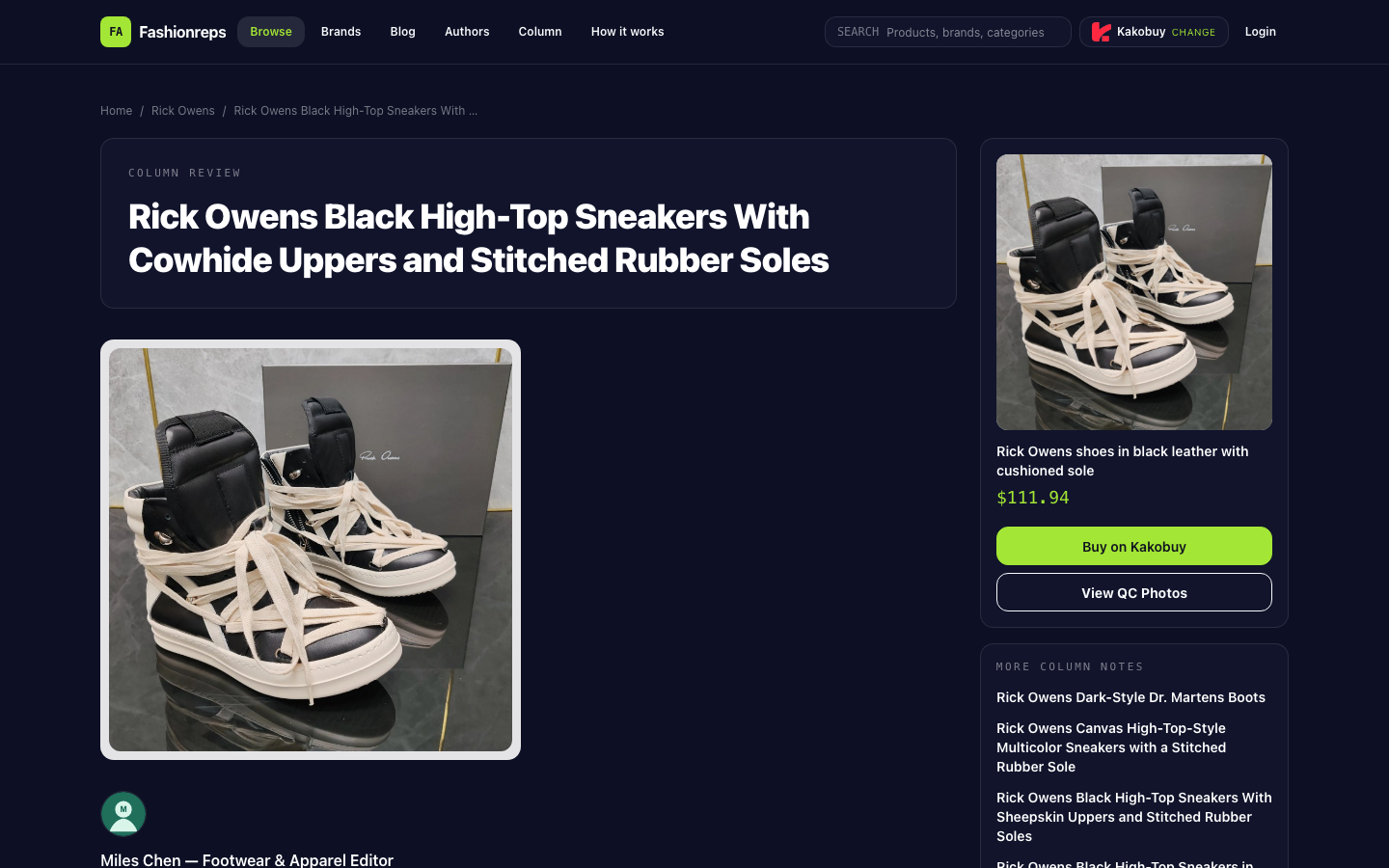
Sizing advice for these Rick Owens black leather high-tops cannot be simply summed up as "true to size" or "size down across the board." The product page lists a cowhide leather upper, stitched rubber sole, lace-up closure, black colorway, and unisex sizing 36–47; however, existing sizing resources for similar high-top models are inconsistent, with recommendations ranging from size down one, true to size, to size down half. Therefore, the safest approach is to first measure your own foot length and width, then confirm the insole length and sole details with the seller.

Distinguish Between Product Page Facts and General Sizing Opinions
What can be confirmed from this product page is: this is a black high-top shoe, with catalog details stating cowhide leather upper, stitched rubber outsole, textile insole and other material lining, lace-up structure, and size range 36–47. The page also mentions a high-top opening depth of approximately 7–11 cm and lists it as an all-season style.
These are catalog information, not independent test results of the actual product. Currently, this SKU has no independent buyer reviews or buyer-measured records, so one cannot confirm the upper feel, actual weight, durability, or the true fit of any size.
Community-level advice is conflicting: some suggest sizing down one for similar Rick Owens high-tops, others recommend true to size, and some resources suggest sizing down half. Another sizing resource states that for some Rick Owens models, the insole length may be about 1 cm longer than the actual foot length, but this pattern has not been verified with insole measurements for this specific product page, so it cannot be directly applied to these shoes.
Match Size Using Foot Length, Foot Width, and Insole Inner Length
First, measure while wearing the socks you plan to pair with the shoes. Stand with your heel against a wall, let your toes relax naturally, mark the front of your longest toe, then measure the distance from the wall to the mark. Measure both feet separately, and use the longer one as the main reference.
Also record foot width, especially if you have a wide forefoot, high instep, or are prone to pressure from the shoe upper. The upper and opening of high-top shoes affect ease of entry and the wrapping sensation, so you cannot just look at the size number. If the foot length is suitable but the forefoot is already under noticeable pressure, continuing to choose a smaller size usually increases the risk of pinching.
Then ask the seller for the insole inner length of the corresponding size. Insole inner length is not the outer sole length, nor the metric size marking on the page; confirm whether the measurement is of a removable insole, or the effective length inside the shoe from heel to toe. If the insole is not removable, ask the seller to explain the measurement method and provide a photo with a ruler.
You can judge in the following order:
- Base your decision on the actual foot length of the longer foot; do not apply the "size down one" conclusion prematurely.
- Use foot width and instep height as secondary filters; for wide feet or high insteps, prioritize eliminating sizes that are obviously too narrow.
- Compare the insole inner length provided by the seller, not just the size numbers like 36, 37, 38.
- Ask whether the insole is removable, whether it includes extra cushioning space, and whether the high-top opening restricts the instep from entering.
- If the seller cannot provide measured data for the corresponding size, mark the sizing as unconfirmed; do not treat general advice as measured results for these specific shoes.
Why Both High-Top Opening and Insole Allowance Matter
For low-top shoes, the main concern is toe and forefoot space; for high-top shoes, you also have to deal with the instep entering the opening, the wrapping of the high-top collar, and pressure after lacing. Even if the toe length is sufficient, a too-tight opening can cause difficulty putting on and taking off; conversely, a loose opening but an overly long insole may cause the foot to slide forward and backward inside the shoe.
The product page mentions a high-top opening depth of about 7–11 cm, but this is not the circumference of the opening, nor does it directly represent what kind of instep height is suitable. Actual comfort also depends on the lace hole positions, upper softness, insole thickness, and last shape, and there is currently no buyer-measured evidence for this SKU.
If you have wide feet, you cannot mechanically follow "size down one." Existing general resources clearly state that wide-foot buyers may need to size up in narrower similar models to avoid forefoot pressure; however, this is still style-level advice, not a specific size commitment for this product. Wide-foot buyers especially should first obtain insole width, insole inner length, and photos of the upper opening.
Evidence to Request from the Seller Before Ordering
Focus on questions that can directly change your purchasing decision:
- Insole inner length for your target size, ideally with a photo showing a ruler from heel to longest point.
- Forefoot width of the insole, and whether the insole can be removed for measurement.
- Outer sole length, forefoot width, and heel width, to help infer internal space, but not as a substitute for insole data.
- Close-up photos of upper stitching, sole attachment, tongue label, heel logo, and sole tread pattern.
- Whether QC photos of the actual pair can be provided before shipping, and how obvious flaws would be handled.
- Return and exchange conditions, return address, time limit, and any associated fees.
Stitching, labels, and sole details are worth verifying because there are many replicas of this type of Rick Owens high-top, and general authentication advice also lists these areas as key checkpoints. However, a few photos alone cannot prove authenticity, and the catalog description on the product page should not be treated as an independent authentication conclusion.
When to Hold Off on Ordering
If any of the following occurs, the sizing risk remains unresolved:
- The seller only provides a size chart, without actual insole or inner shoe measurements for your target size.
- The seller cannot explain whether the measurement is insole inner length, inner shoe length, or outer sole length.
- Your foot width or instep is significantly outside the norm, but there are no photos of forefoot width and opening details.
- The page does not clearly state return and exchange terms, and you cannot accept the loss from an ill-fitting size.
- The product link, stock, or final costs have not been confirmed on the purchasing agent platform.
The page displays a reference price of $111.94, with a strikethrough amount of $124.20; the final product price, service fees, and international shipping costs still need to be confirmed on the purchasing agent platform, and the actual landed cost cannot be estimated from the reference price. There is also insufficient evidence to confirm stock status, so you should re-check product availability before ordering.
Conclusion: Get Insole Data First, Then Decide on Sizing Down
These shoes are suitable for buyers willing to verify sizing themselves and accept individual differences in high-top leather shoes. For those with narrow feet and a clear sizing history in similar high-tops, "size down one, true to size, and size down half" can be treated as options to verify; for those with wide feet, high insteps, or no experience with similar models, prioritize obtaining insole inner length, forefoot width, and opening photos, and do not blindly follow community advice.
If the seller cannot provide measured information for the corresponding size, or there is no clear return/exchange path, the most reasonable decision is not to guess a size, but to hold off on purchasing. The current evidence is sufficient to help you establish a verification process, but not enough to guarantee that a specific size will fit.
Editor score 4.2 / 5
Community feedback
3 approved
Reader score 4.7 / 5 (3 ratings)
Good reminder that leather can feel stiff at first. I measured the insole rather than guessing from my usual sneaker size, and that gave me a much better starting point. Check width too if your feet run wide.
The mixed advice is real. I went true to size and they fit well with regular socks, though getting the heel snug took some lace adjustment. Would love to see measurements for a few sizes side by side.
Measuring the insole was the key for me. My usual size felt roomy in the toe, but the high-top shape made sizing down a full size seem risky. Definitely compare the actual insole length with a pair you already wear.